
LGSF vs RCC: Which Is Better for Fast-Track Construction in India?
A practical, cost-and-time comparison between Light Gauge Steel Framing and conventional RCC construction for Indian developers.
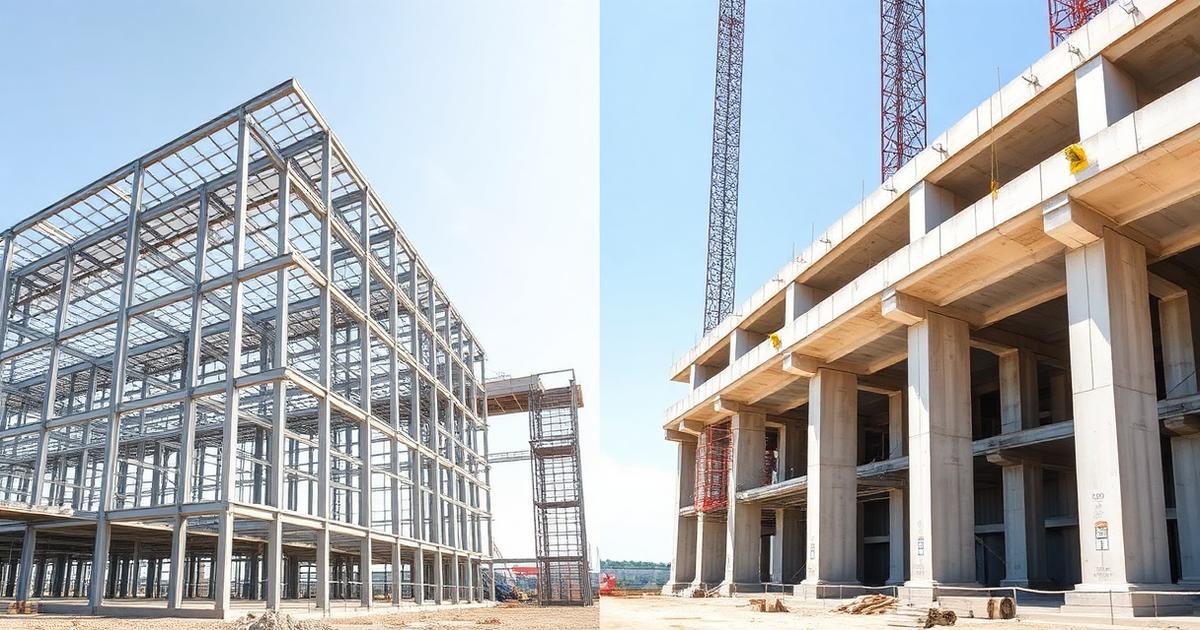
Every developer in India eventually asks the same question: should we build in conventional RCC, or move to Light Gauge Steel Framing (LGSF)? The honest answer depends on the building — but for a growing share of projects, steel now wins on the metrics that matter.
The short answer
| Factor | RCC | LGSF | | --- | --- | --- | | Speed on site | Baseline | 30-50% faster | | Weather dependency | High | Low | | Structural dead load | Heavy | Up to 60% lighter | | Dimensional accuracy | ±10-15 mm | ±1-2 mm | | Site waste | High | Minimal | | Design changes late in build | Expensive | Difficult, plan early |
1. Speed is the real cost saving
RCC construction is sequential and cure-bound. Every slab needs shuttering, pouring, curing and de-shuttering before the next level begins. LGSF panels are roll-formed off site to CAD tolerances and bolted together on arrival, so a floor can be framed in days rather than weeks.
For a commercial developer, the saving is rarely in the raw material rate — it is in finance cost, site overheads and earlier revenue. Pulling six months out of a 24-month programme routinely outweighs any premium on the frame itself.
2. Load and foundations
LGSF structures weigh a fraction of an equivalent RCC frame. Lighter superstructure means smaller footings, less excavation and less reinforcement below ground — a genuine saving on soft or filled soils, and a strong advantage for vertical extensions on existing buildings.
3. Quality and predictability
Steel sections are manufactured, not mixed. There is no slump variation, no honeycombing, no rebar congestion. Every stud, track and connection is modelled before fabrication, so what reaches site fits. Services routing is pre-punched into the studs, which removes chasing and re-work by MEP trades.
4. Where RCC still makes sense
Be even-handed. RCC remains a strong option for basements and retaining structures, for very tall towers where mass and damping matter, and for projects where the client requires a fully conventional supply chain. Most real projects end up hybrid: RCC cores and basements, composite steel or LGSF above.
5. Seismic and fire performance
India's seismic zones favour lighter buildings — inertial forces scale with mass, so an LGSF structure attracts far less seismic load. On fire, galvanised steel framing is non-combustible; rated performance is achieved through the board and insulation system, with 60-120 minute assemblies being routine.
Making the decision
Ask three questions:
- Is speed to occupancy worth money to you? If yes, steel is usually cheaper in total cost.
- How repeatable is the geometry? Repetition multiplies the benefit of off-site manufacture.
- How firm is the design? Steel rewards decisions made early and punishes changes made late.
Beycon engineers both systems and will tell you plainly when RCC is the better answer. If you have a live project, share the drawings and we will run a comparative programme and cost view.
Planning a project?
Beycon engineers composite steel and LGSF buildings across India. Share your drawings and we'll return a programme and budget view.
Talk to us ↗